Clover is a design pattern system developed to bridge the gap between Salesforce’s corporate climate goals and individual employee action.
Team
Anvesha Gawade, Arathi Pallath
Arjun Raghavan Venkatraghavan,
Atharva Patil, Effy Banach &
Samiksha Pawar
My Role
Synthesize research, research framing, ideation, prototyping, documentation, and presentation.
Tools
Figma, Google Forms, Miro
September 2025 - November 2025

We started with a question...
How might we empower Salesforce employees to take sustainable actions as a part of their daily workflow, while also minimizing disruptions?
Clover is designed to connect Salesforce’s climate goals with employee action by delivering passive and active nudges that guide sustainable decisions without disrupting workflow.
Our research into energy consumption focused on digital energy use within digital tools used at work, rather than traditional office utilities like lighting. This was important as Salesforce operates as a cloud based, digital first organization where a significant portion of its environmental footprint is tied to data usage, computation and digital collaboration tools.
Clover prompts with..

Conditional, context-aware nudges triggered by user actions that highlight avoidable energy costs and gently prompt more sustainable choices with metrics that are relatable.
Active nudges that intervene before a high-power decision, like trying to upload a large file, scheduling a meeting, or choosing call settings.

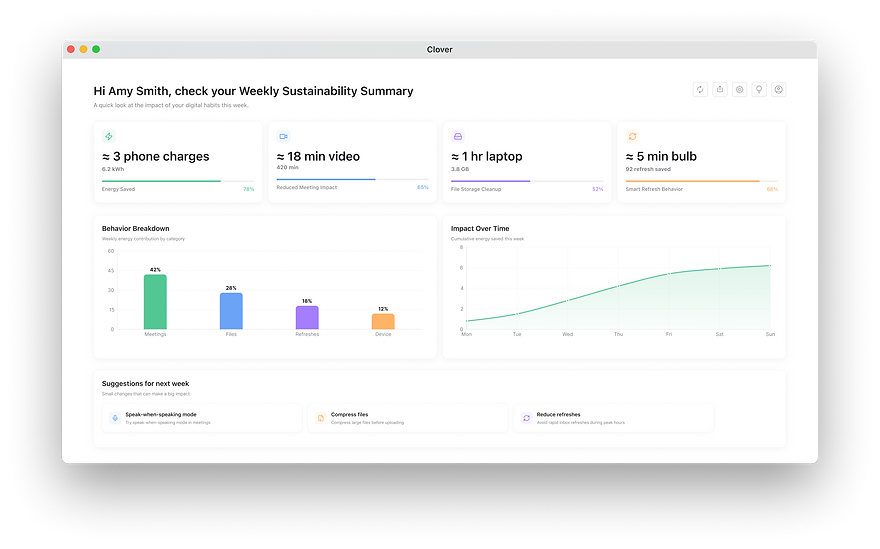
Dashboard for impact framing that translates invisible energy data into human language
Project Painpoints
Lack of Unified Sustainability Tools: Employees lack a consistent and integrated way to act sustainably across Salesforce products, making behavior change fragmented and hard to maintain.
Low Visibility of Personal Impact: Without clear framing, employees often don’t understand how small actions contribute to broader climate goals, leading to disengagement.
Unclear Data Boundaries: Users often don’t know what metadata is collected, how it’s used, or who can access it—leading to hesitation or refusal to opt in.
How Clover approaches it
From Product to Pattern: Rather than a standalone app, we designed a scalable set of 6 Design Patterns (Nudges, Impact Framing, Automation) that can be integrated into existing Salesforce tools (Slack, Tableau, Sales Cloud).
Behavioral Science Foundation: Grounded in the BJ Fogg Model, the system optimizes for "Ability" and "Prompt," intervening only when the behavioral cost is low.
Privacy First Architecture: To ensure adoption by Engineering and Legal, the system relies on local first metadata analysis, avoiding content inspection to maintain user trust.
Discover
Research & Exploration
Why are climate initiatives not having the intended impact across this industry?
Conducted a comparative analysis between big tech companies and start-up companies to see what sustainability initiatives they are taking.
.png)
.png)
Finding
Carbon and energy tracking shames the user for their resource usage and discourages them from feeling empowered to make reasonable change.
Opportunity
Should take a friendly and gentle approach to nudging the user towards resource-saving actions.
Finding
Habit-tracking through the lens of sustainability, relying on self-reporting and hollow incentives to keep an employee motivated.
Opportunity
Utilize automatic progress tracking, rather than the honour code.
Finding
Solutions all lived completely outside of existing employee workflows, leading to them feeling like an afterthought.
Opportunity
Solution should exist within the existing employee workflow.
Finding
Gamification doesn’t lead to long-term behavior change, it often fails to build real awareness or create meaningful moments for users to take action
Opportunity
Shifting from gamification to behaviorally informed, context-aware design that supports long-term habits.
Define
What does sustainability mean at an employee level?
Our research into energy consumption focused on digital energy use within digital tools used at work, rather than traditional office utilities like lighting. This was important as Salesforce operates as a cloud based, digital first organization where a significant portion of its environmental footprint is tied to data usage, computation and digital collaboration tools.
To better understand employees' mental models and motivation when it comes to sustainability, we sent out a survey to Salesforce and other corporate company employees and received 21 responses. Our objective was to learn three broad themes: what does sustainability mean to them personally, their awareness of the energy they consume in the office, and motivate them to make a sustainable change.
.png)
We found that many everyday workplace activities such as video calls, cloud storage, real time dashboards, and background application refreshes consume energy continuously, often without employees being aware of it. Studies show that practices like keeping cameras on during long meetings, maintaining multiple live dashboards, or storing redundant files can significantly increase energy use at scale. However, these costs remain largely invisible to individual employees.
A recurring insight we got was that awareness alone is insufficient. While employees may broadly care about sustainability, abstract metrics like kilowatt hours or carbon equivalents are difficult to interpret and rarely lead to sustained behaviour change.
So the direction we took was:
-
Contextual in the moment interventions
-
Framing impact in relatable, human scale terms
-
Reducing the effort required to act sustainably
Develop
Design Patterns
Clover is Bigger than a tool
We designed the following six patterns that provide a scalable blueprint, so that Salesforce can apply them across tools, teams, and workflows to quietly reduce digital emissions at a massive scale. These patterns embed sustainability into everyday work practices, enabling large-scale impact through subtle, contextual interventions.
Embedded Nudge
Embedded Nudge involves subtle cues woven directly into existing interfaces, designed so that sustainable behavior does not require users to switch tools ot interrupt their workflow. By placing them within routine interactions, these nudges lower the cognitive and behavioural cost of making sustainable choices.
For example, when a person is trying to schedule a meeting, but most of them are in the same office, the system nudges them to have an in-person meeting instead.

Passive Nudge
Passive nudges appear while the user is in the process of performing an action such as joining, uploading, or sharing, at the moment when unnecessary power consumption can still be prevented. These nudges do not block actions but offer timely prompts that encourage reflection.
For example, a nudge that reminds the person to turn off their camera to save energy, as other participants in that meeting have done so.

Active Nudge
Active nudges are upstream nudges that intervene before a high-power decision is carried out such as scheduling a meeting, choosing call settings, or selecting a file size.
In this example, Clover nudges a user who is trying to upload a large file. It comes into action just before a high-impact action.

Impact framing
Impact framing translates abstract energy metrics into relatable metrics. We learned people don’t relate to kilowatt-hours. So we frame energy in everyday equivalents making environmental impact meaningful to the users: such as ‘minutes of projector time saved,’ or ‘hours of device power avoided.’ It turns invisible consumption into something tangible.
This is reflected in the dashboard metrics that we considered.
.png)
Reinforcement
Reinforcement supports the development sustainable habits by providing feedback on individual action, team-level progress and milestones, and shared wins. By recognising these achievement, this pattern leverages social motivation and makes sustainable behavior rewarding.
In the example, the system tells the user about the collective positive impact of their choices.

Automation
In a future concept, patterns could automate certain steps, compress files, toggle video, sleep devices, but only when the energy saved is far greater than the energy used.

Across all these patterns, we designed the nudges to:
-
Highlight positive impacts when good sustainable choices are made rather than penalising users for not making them.
-
Encourages behavioural change at moments where actions can still be altered.
-
Gradually shifting conscious decisions to habitual behaviour
-
Integrate seamlessly into existing workflow to minimise disruption and resistance.
Deliver
Final Outcome
How does Clover work?
Clover starts in the corner of the screen as a translucent widget that doesn’t take attention away from the users. It is silent before it detects a trigger.
Scenario - Clover detecting older files using significant cloud storage.

When an avoidable action is detected, the Clover icon turns green, which grabs the user’s attention. If we consider the BJ Fogg Behavior Model, this notification prompt during their workflow gives them a nudge, which is simple and low effort, giving them the ability to act on it.
.png)
In this case, once the user chooses to open the notification, they see the impact that their sustainable action will have. This is not a forced action but a suggestion that can drive value in the future. By showing them the emissions they have saved, it motivates them to act on it.
.png)
Through our feedback, we also understood that the users want to see the impact that they’ve created over time to keep motivating them to make sustainable choices. In this scenario, we see that users are given a smaller nudge when a weekly summary is ready for them, when the icon turns blue. Once they open this notification, they see an impact statement and, if they wish, are prompted to see the detailed analysis in a dashboard.

Integration with Apps
Clover is integrated with different apps such as Zoom, Google Drive, Slack, and many more. These integrations are again customizable by the users to change privacy permissions as required. The reason for this integration is to understand active and passive nudges. Let’s see some examples of these actions inside different applications in context to the design patterns we created and the decisions made to create the dashboard statistics.
Challenges and Future Work
Nudge Timing & Fatigue
Nudges risk being ignored if poorly timed or too frequent. Clover minimizes this by appearing only when contextually relevant, but formal governance rules are still needed.
Privacy & Trust
Enterprise adoption depends on strict privacy. Clover uses local-first, metadata-only analysis with opt-in integrations, but questions around regional laws, role-based visibility, and IT workflows remain.
AI Trade-offs
AI could improve personalization but increases energy consumption. Future work must evaluate energy savings vs. costs and ensure transparency around AI use.
Long-Term Behavior Change
Initial feedback is positive, but lasting change requires cultural reinforcement, habit-building strategies, and clear alignment between sustainability and productivity.
Technical Feasibility
Clover spans many tools, making implementation complex. It is a pattern system—not a single feature—and will require phased rollout and clarity on what needs native platform support.